


#16 The PEAS Fellowship: A unique mentoring opportunity
In its second inaugural year, the Plant, Environmental, and Agroecology Sciences (PEAS) fellowship welcomed four new undergraduate students to pursue their research interests in sustainable agricultural systems. The fellowship, run through the Undergraduate Research Center and the Department of Plant Sciences, supports students in the development, execution, and presentation of a research project conducted within a lab in the College of Agriculture and Environmental Sciences. Students take a spring seminar to meet their PEAS cohort and learn the aspects of designing a successful project. Throughout the summer, the fellows conduct their research, culminating in a research symposium with other undergraduate fellowship programs. In the following spring, students are expected to present at the UC Davis Undergraduate Research Conference.
This year’s research projects covered many aspects of sustainable food systems: genetics and breeding (Chen Li, Brummer Lab), pest management (Princesa Ceballos Madrigal, Corteva Agriscience), soil health (Itzel Villagran, Lazcano Lab), and food quality and nutrition (Morgan Wlaschin, Lundy Lab).
Each PEAS fellow is mentored by graduate students, postdoctoral researchers, and professors in their lab throughout the process. Mentoring is at the heart of academia. It is a large part of how students become successful researchers and change-makers (Jacobi, 1991; Chandler, 1996), though the role of mentor goes beyond challenging the mentee in their academic performance. Mentorship also encompasses support for professional development and psychological well-being (Marino, 2020).
Classically, graduate students are mentored by their major professor, but mentoring relationships are abundant throughout academia. Mentoring can also exist across disciplines and scales: faculty mentor undergraduate students, post-docs mentor graduate students, graduate students mentor each other. The relationship that is cultivated between mentor and mentee is a critical component of successful mentorship. Research shows that this relationship is especially important for mentees from an underrepresented group in academia (Deanna et al., 2022).
Despite the somewhat obvious conclusion that mentorship has proven to be beneficial for both the mentor and mentee, modern graduate student curriculum often does not include lessons on how to be a good mentor, nor are students exposed to many structured mentoring opportunities (Harvey, Ambler & Cahir, 2015). The PEAS fellowship provides a unique opportunity for undergraduate students to cultivate a relationship with a mentor in a structured program and for graduate students, post-docs, and professors to practice and develop their mentoring skills.
Morgan Wlaschin, whose research focused on how water stress impacts the nutritional composition and quality of wheat, was mentored by Mark Lundy (PI) and Maya Shydlowski (graduate student). The following text includes anecdotes from Morgan and Maya on Morgan’s PEAS project and their mentor/mentee experience.
Morgan Wlaschin, Mentee:
Wheat plays a significant role in my everyday life. Working in the Grain Cropping Systems (GCS) Lab, I’ve learned the essential role agronomy plays in grain cropping systems and importance of efficient production to improve conditions for growers, consumers, and the environment. Wheat has also given me the opportunity to connect with others through baking. Maya, my PEAS mentor, and I connected over this when I was assisting her and Mark with the lab's field trials. While we were curious and eager to learn about agronomy from the lab, we both enjoyed baking and frequently chatted about sourdough techniques, flour types, and all things baked goods. Thus, when we decided to work on the PEAS Fellowship together, our passion and curiosity about agronomy and baking led us to investigate the connection between the two. We then narrowed the project to explore how varying degrees of water stress impact the nutritional and baking quality of common wheat grown in California.
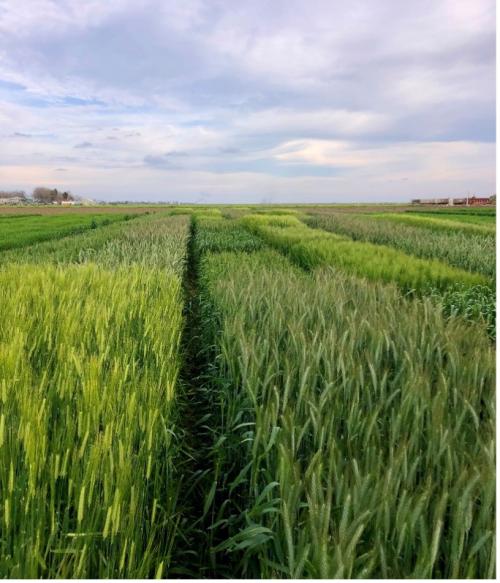
Image 1: Snapshot of a small grains variety trial conducted by the Grain Cropping Systems Lab in Fresno County, California.
To better understand how water stress affects wheat nutritional and baking quality, we grew common wheat in two water-stressed environments: one with minimal irrigation at establishment and one without any irrigation (rainfed). I then conducted grain, flour, and bread quality measurements at the California Wheat Commission with the help of Teng Vang, Alejandra Andrade, and Claudia Carter.
After conducting these tests, I analyzed the data by learning to code in R and interpreted the results by collaborating with the California Wheat Commission. We found improved dough strength and baking quality with minimal irrigation, despite lower grain protein than in the rainfed condition. We then compared these results to those from a previous study of common wheat varieties grown under full irrigation and partial irrigation. Patterns across a broad range of water environments suggest that, under moderate water availability, dough quality is maximized, and under fully irrigated and rainfed conditions, the quality declines again. These insights can inform how grain processing and baking might be adjusted in response to increasing drought affecting wheat production.

Image 2: Undergraduate Morgan Wlaschin performs baking quality tests at the California Wheat Commission lab.
Conducting this experiment throughout the summer was challenging but extremely rewarding, and I gained many valuable takeaways. Reflecting on my time as a PEAS fellow and collaborating with Maya and Mark, my research, critical thinking, and communication skills have improved considerably. I learned that active communication, planning, and accepting feedback are critical when working in a team. Maya and I had weekly meetings where we proactively addressed obstacles in data collection and coding, implemented project timelines, and she provided me with constructive feedback and ideas on my writing and presentations. Along with teaching me extremely valuable skills, Maya and Mark were also fantastic support systems throughout my project. They did a great job of knowing when to guide me through complex tasks and when to step back and challenge me to problem-solve and communicate my work independently.
Additionally, through the mentorship, I’ve learned how valuable a dedicated mentor can be to a student. Never letting an opportunity pass her by, Maya made the most of them and tackled them head-on. She continues to teach me how to approach opportunities and challenges with agency and confidence. She has been a transformative role model for me throughout my college career, and I hope to do the same for someone else in the future.
My experience and the skills I have acquired through this fellowship have also been extremely valuable in narrowing down my career interests. I found it fulfilling to go through the entire research process, conduct meaningful research, and learn to troubleshoot and address key issues during the project progression. After taking a gap year, I plan to attend graduate school and hope to continue working in agricultural research. If possible, I want to further explore where agronomy meets food science, processing, and other subject areas further along the supply chain within sustainable food systems.

Image 3: Undergraduate Morgan Wlaschin presenting her work at the CANVAS 2025 conference in Salt Lake City, Utah. This poster presentation earned her first place in her division!
Maya Shydlowski, Mentor:
When I suggested that Morgan apply for the fellowship, I knew I was signing myself up for a project as well. I was excited about the opportunity to mentor Morgan, both because I knew she was a bright student who was curious and passionate about the work we did in the lab, but also because I wanted to continue to develop my mentoring skillset.
While TAing the previous fall quarter, I had students ask me to read over grad school applications or just chat with them about school and jobs in agriculture. I enjoyed this interaction with my students and decided to pursue another mentoring opportunity through the EnvironMentors program, which was just revamped at UC Davis last year after a hiatus during the pandemic. In this program, I teamed up with other graduate students to support a high school student as she conducted her own research experiment from start to finish, including a poster presentation at the national EnvironMentors symposium.
In the middle of this program, Morgan applied for the PEAS fellowship. My advisor, Mark Lundy, was supportive of the project. Together, we taught her how best to explore her ideas and vision for the project. Throughout the brainstorming and application process, I was able to give Morgan tips on experimental design and writing that I had picked up in my experience applying to graduate school. Then, as her project began to develop, I used the tools I learned from my advisor and in my classes to support and guide her through the various aspects of project development and research – budgeting, literature review, time management, coding and statistics, and analysis.
Mentoring a student for the PEAS fellowship was a learning experience. Of course, Morgan’s research gives us new insight into how our management affects post-harvest and baking quality of grain. But most of all, being a part of this program allowed me to develop my own skills and learn more about myself as a researcher and leader. Morgan was kind enough to be my guinea pig as we dove into this mentorship opportunity.
I’ve been lucky enough to work with Mark and a few other professors who have mentored me as I navigate academia. What I learned from them helped me to support Morgan in her success in the PEAS fellowship – all the way to a national conference poster win!

Image 4: Maya Shydlowski (left), Morgan Wlaschin (center), and Mark Lundy (right) stand in front of Morgan’s poster at the CANVAS 2025 conference in Salt Lake City, Utah.
Beyond this project, Morgan and my mentoring relationship has served us both. I rely on Morgan for feedback on my research presentations from an undergraduate level and for her insight into what makes a good TA and research mentor. I continue to support Morgan in her career exploration and academic pursuits. We discuss research ideas and the broader impact of our work on food systems locally and globally.
I urge graduate students and others in academia to put the time and effort into learning how to be a good mentor, to gain experience as a leader, and to take opportunities to build up the next generation of students. You’ll learn how to be a better researcher and leader in the process.
References
Chandler, C. (1996). Mentoring and Women in Academia: Reevaluating the Traditional Model. NWSA Journal, 8(3). https://www.jstor.org/stable/4316462
Deanna, R., Merkle, B. G., Chun, K. P., Navarro-Rosenblatt, D., Baxter, I., Oleas, N., Bortolus, A., Geesink, P., Diele-Viegas, L., Aschero, V., de Leone, M. J., Oliferuk, S., Zuo, R., Cosacov, A., Grossi, M., Knapp, S., Lopez-Mendez, A., Welchen, E., Ribone, P., & Auge, G. (2022). Community voices: the importance of diverse networks in academic mentoring. Nature Communications, 13(1). https://doi.org/10.1038/s41467-022-28667-0
Harvey, M., Ambler, T., & Cahir, J. (2017). Spectrum Approach to Mentoring: an evidence-based approach to mentoring for academics working in higher education. Teacher Development, 21(1), 160–174. https://doi.org/10.1080/13664530.2016.1210537
Jacobi, M. (1991). Mentoring and Undergraduate Academic Success: A Literature Review, 61(4).https://doi.org/10.3102/00346543061004505
Marino, F. E. (2020). Mentoring gone wrong: What is happening to mentorship in academia? Policy Futures in Education, 19(7), 747–751. https://doi.org/10.1177/1478210320972199
Other Resources for Mentors and Mentees
Best Practices for Mentors and Mentees in Academic Settings
Academic mentoring for researchers: what is it and how does it work? https://authorservices.taylorandfrancis.com/blog/mentoring-support/academic-mentoring-for-researchers/
UC Davis Grad Studies Resources for Mentors
https://grad.ucdavis.edu/resources-mentors
UC Davis Grad Studies Resources for Mentees
https://grad.ucdavis.edu/mentoring-resources-mentees
UC Davis Human Resources Mentoring Toolkit
https://hr.ucdavis.edu/departments/learning/toolkits/mentoring